Strong roots,
stronger coffee.
Every cafecito, a story.
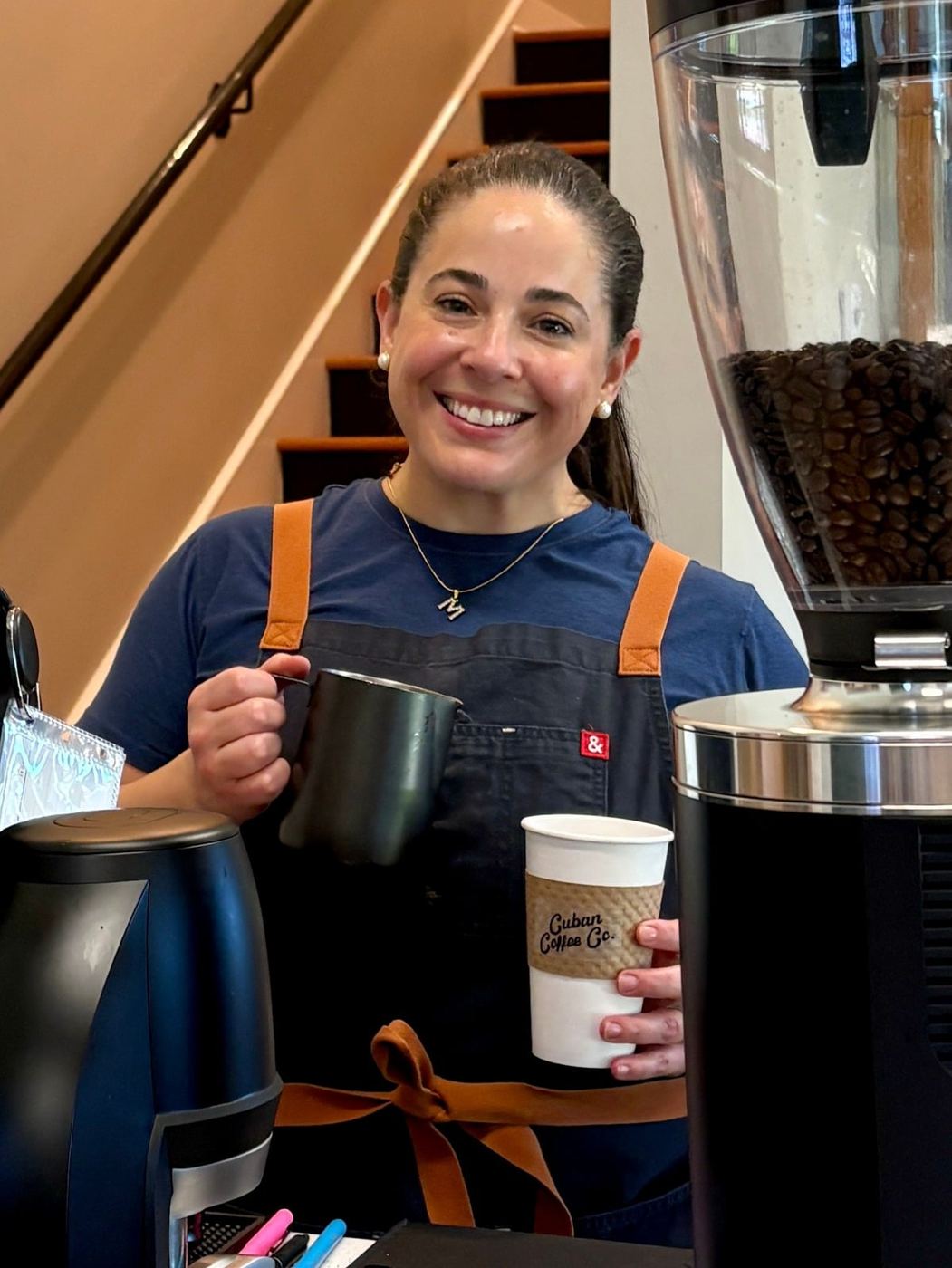
In Miami, where I'm from, there's always a reason for coffee. By 3pm someone in the office is already shaking the metal pitcher, working the first drops of espresso into sugar until it turns to espumita, that thick caramel foam that has to form before anyone gets their cafecito. Or it's a stop at the ventanita for a colada and a pastelito on the way to anywhere.
I'm not Cuban. I'm Nicaraguan, raised in Miami, married into a Cuban family. In Miami, you grow up around Cuban coffee before you understand what it is: at school pickup, at the corner bakery, in every office break room by 3pm. What my husband's family gave me was a deeper understanding of the grit behind it.
His grandmother, Mima, and grandfather, Pipo, escaped Cuba with nothing but their two little girls and the clothes on their backs. The government took everything else they owned before they left. What they carried out was memory, language, recipes, the moka pot ritual, things no government can take. They wanted something better for their daughters, and they were willing to start over with nothing to get it.
My own family has a version of that same story. My parents fled Nicaragua during the Sandinista revolution, when I was two years old. Before we left, they sold everything they owned to a man who paid them in counterfeit bills, so the money that was supposed to fund our new start turned out to be worthless paper. We left with nothing. No money, no belongings, just each other and me. They started over in a country where they didn't speak the language, from absolute zero.
There's a kind of quiet that settles into people who've had to leave everything behind and rebuild somewhere new, a steady acceptance that becomes its own kind of strength. You hear it in Willy Chirino's “Ya Viene Llegando,” one of the most beloved songs in Cuban exile culture, a song about what people carry when they can't take anything with them, and about still believing, decades later, that the place they left will someday be free. What surprised me, going back to it, is that the song doesn't only sing for Cuba. It names Nicaragua too, right alongside it, a parallel that was already part of the culture I grew up around, long before I started writing this story.
I carry both of those histories, my husband's family's Cuban one and my own family's Nicaraguan one. Two countries, one pattern. People who lost everything and rebuilt anyway. I'm not here to make a political point. Cuba and Nicaragua are still living under the same kind of governments my family fled, and that's just history, not a debate I'm looking to have. I don't take for granted that I get to work hard, build something, and earn a living from it. That's not guaranteed everywhere. Here, it is, and I don't waste it.
Before Cuban Coffee Co., I owned a coffee shop in Hampstead, North Carolina. That chapter taught me exactly what I did and didn't want to build, and it gave me the clarity to walk away and start over, on a much smaller scale than what Mima and Pipo or my own parents faced, but built from the same instinct. If something isn't right, you don't stay in it out of fear.
You start over.
Cuban coffee is rarely grown in Cuba. What's sold as Cuban coffee in the US is beans grown somewhere else and roasted dark, often past the point of tasting like anything but char. We don't source “Cuban” beans, because there mostly isn't such a thing to source, and we're not interested in pretending otherwise.
What makes Cuban coffee Cuban is the method: the moka pot, the espumita worked by hand, a ritual passed down instead of written down. That's what we're bringing to North Carolina. It's a story about a culture that turned a cup of coffee into a daily excuse to stop, gather, and be around people you love.
— Melissa
A little Cuban coffee vocabulary
Tap a card to flip it.
Bring the ritual to your event
Weddings, offices, showers, and community gatherings. Let's make your event a daily-excuse-to-gather kind of moment.